Nasdaq Falls 0.74% on Hot CPI, VIX Eases to 19.46: Closing Notes for Tuesday
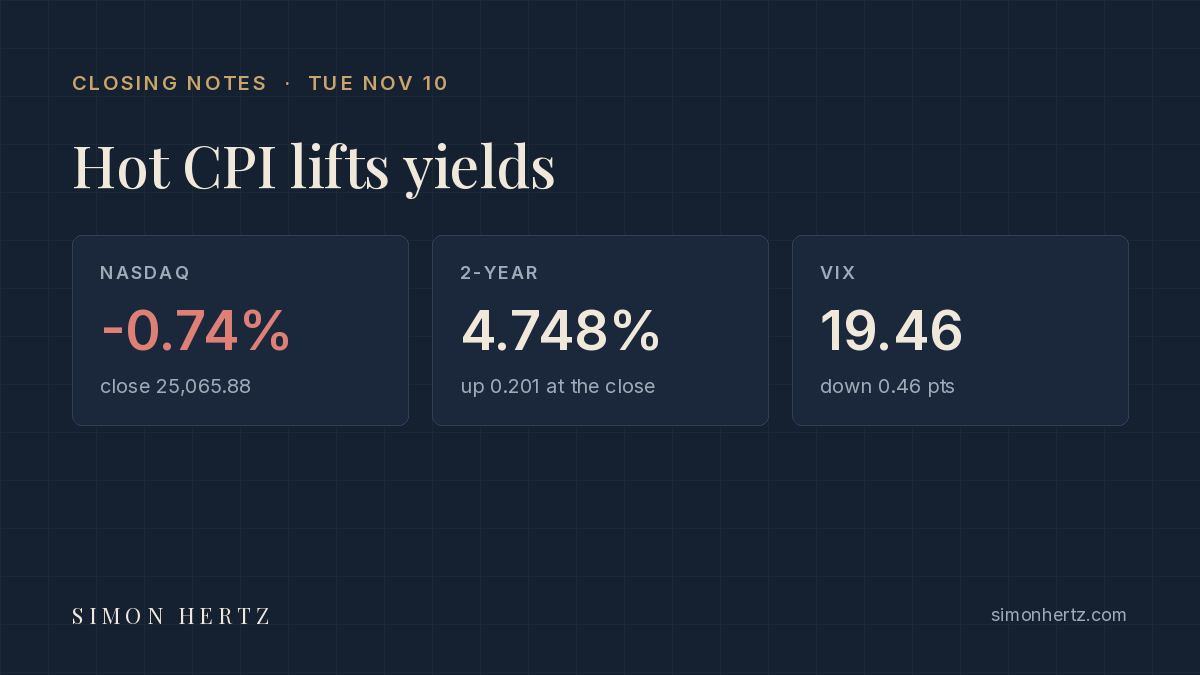
Tuesday, November 10, 2026: October consumer prices came in hotter than expected, and the bond market took the hit first. Short-dated Treasury yields jumped, the 10-year closed at 5.00%, and stocks gave back part of Monday’s broad rally, with chipmakers and the big cloud names doing most of the damage. Losses were modest at the index level, and the VIX actually drifted lower once the number was out.
How the session closed
- Indexes. The S&P 500 fell 29.01 points, or 0.38%, to 7,520.93. The Nasdaq Composite lost 187.26 points, or 0.74%, to 25,065.88. The Dow slipped 157.86 points, or 0.30%, to 52,231.89. The Russell 2000 fell 19.44 points, or 0.68%, to 2,821.38 (Yahoo Finance, CNBC).
- The CPI print. Headline consumer prices rose 0.4% in October against a 0.3% consensus, and core prices rose 0.3% against 0.2% expected (Trading Economics).
- Fed pricing. The hot reading, alongside hawkish remarks from Fed officials, reinforced expectations of a quarter-point rate increase in December, with money markets assigning some chance to a larger move (Trading Economics).
- Chips and cloud. Nvidia fell for a second session, closing at $168.89, down $9.78 or 5.47% (Yahoo Finance). Micron, Microsoft and Oracle also declined (Trading Economics).
- VIX. 19.46, down 0.46 points or 2.31% (CNBC, Yahoo Finance).
- Yields. The 2-year Treasury yield rose 0.201 to 4.748%, the 10-year rose 0.138 to 5.00%, and the 30-year rose 0.102 to 5.358% (CNBC, 5:05 p.m. ET).
- Auction. Today’s 10-year note auction cleared at a high yield of 5.020% (Trading Economics).
- Oil. WTI crude for December traded at $86.44 a barrel, down $0.41 or 0.47%, at 4:59 p.m. ET (CNBC).
After hours
- Nvidia traded at $169.74, up $0.85 or 0.50% from the close, at 5:13 p.m. ET (Yahoo Finance).
- CoreWeave, on the calendar to report after the close, traded at $49.77, up $1.04 or 2.13% from its $48.73 close, at 5:12 p.m. ET (Yahoo Finance).
What it means for options traders
Realized came in well under implied. Monday’s 19.92 VIX worked out to roughly 1.25% a day on the divide-by-16 shortcut. With CPI on the calendar, the S&P 500 moved 0.38%. Even on a surprise to the upside in inflation, the index move fit comfortably inside what options had priced, which is a reminder that a scheduled release often carries more premium than the day’s actual move uses.
A down day with a lower VIX. Stocks fell and the VIX fell with them. That is the classic signature of event premium leaving the front of the curve: the known risk has passed, so the expiration that held it reprices lower, even when the outcome was not the one the market hoped for. Calendar spreads that were long a later expiration and short the event expiration tend to benefit from this kind of front-end decay, as long as the underlying stays near the strike.
The story moved to rates. A 20-basis-point jump in the 2-year is a large one-day repricing of Fed expectations. When rate expectations shift that quickly, equity volatility can stay calm for a session and still respond later, especially in the rate-sensitive and long-duration growth names. Traders watching skew may notice whether put demand builds in the days after a hot print, rather than on the day itself.
Sources
- Yahoo Finance, S&P 500 (^GSPC), Nasdaq Composite (^IXIC), Dow (^DJI), Russell 2000 (^RUT), VIX (^VIX).
- CNBC quotes: .SPX, .IXIC, .DJI, .RUT, .VIX.
- CNBC, US2Y, US10Y, US30Y, WTI crude (@CL.1).
- Yahoo Finance, NVIDIA (NVDA), CoreWeave (CRWV), Earnings calendar, Nov 10.
- Trading Economics, United States stock market and US economic calendar.
Related reading
- Trading Calendars by Simon Hertz, available on Amazon.
- Trading Verticals by Simon Hertz, available on Amazon.
- Trading Iron Condors by Simon Hertz, available on Amazon.
- All titles: Simon Hertz author page on Amazon.
This post is for education only. It is not investment advice or a recommendation to buy or sell any security or option. Options involve risk and are not suitable for all investors. Figures are from the sources listed and may be revised; check primary sources before relying on any number.