Nasdaq Slips 0.39% as Nvidia Sinks on CEO Exit, VIX Rises to 18.70: Closing Notes for Thursday
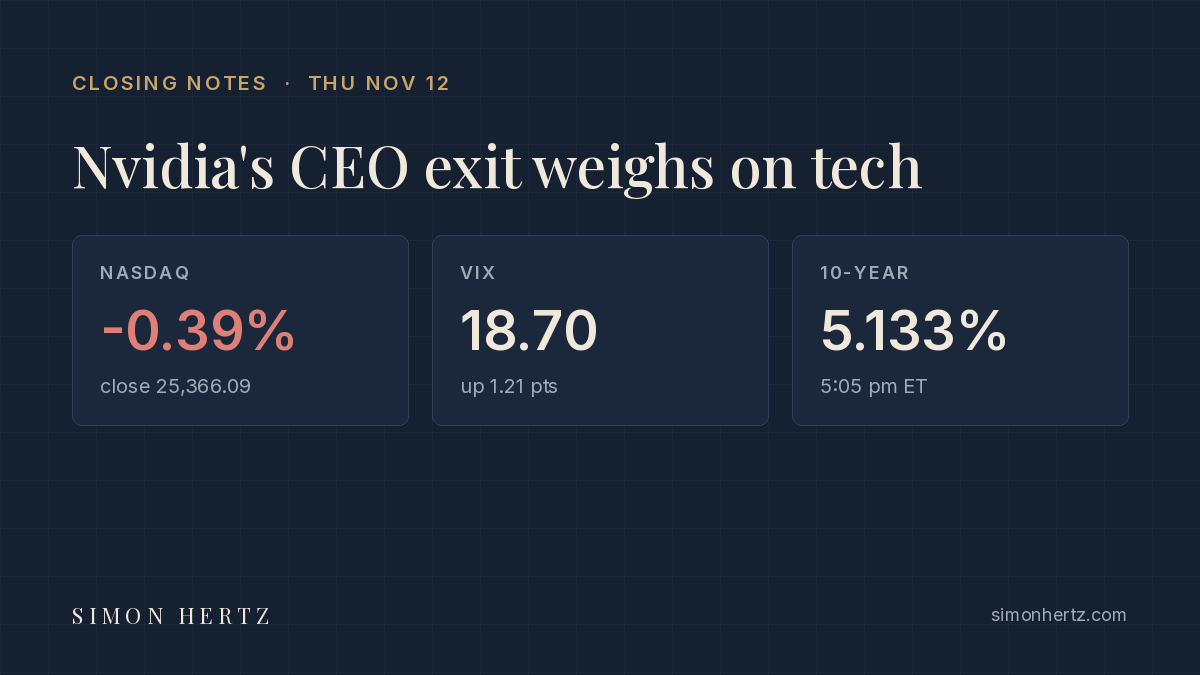
Thursday, November 12, 2026: Wednesday’s chip rebound did not last. Nvidia slid after the departure of CEO Jensen Huang, the AI cloud names fell hard, and Treasury yields jumped as oil rose. All four major indexes closed lower, small caps the most, and the VIX moved back toward 19.
How the session closed
- Indexes. The S&P 500 fell 26.98 points, or 0.35%, to 7,592.40. The Nasdaq Composite lost 100.10 points, or 0.39%, to 25,366.09. The Dow dropped 189.40 points, or 0.36%, to 52,297.09. The Russell 2000 fell 47.20 points, or 1.66%, to 2,799.06 (Yahoo Finance, CNBC).
- Nvidia. The chipmaker closed at $166.19, down $7.54 or 4.34%, as investors weighed the departure of its chief executive (CNBC).
- AI cloud. Nebius closed at $128.64, down 16.84%, after raising its 2026 capital spending forecast to $27 billion and saying revenue would land at the low end of its range. CoreWeave gave back 6.86% to $56.60 a day after its big post-earnings jump. Super Micro Computer fell 11.30% to $26.99 after a Bloomberg News report about a Justice Department inquiry (CNBC).
- Bucking the trend. AMD rose 5.86% to $585.30 after a William Blair upgrade (CNBC).
- Other movers. Corteva sank 24.30% to $9.19 after third-quarter revenue of $1.59 billion missed the $1.77 billion analysts expected. Keurig Dr Pepper fell 7.40% to $35.42 after announcing a proposed $2 billion stock offering (CNBC).
- VIX. 18.70, up 1.21 points or 6.92% (CNBC, Yahoo Finance).
- Treasury yields. At 5:05 p.m. ET the 2-year yielded 4.884% (up 0.157 point), the 10-year 5.133% (up 0.144) and the 30-year 5.458% (up 0.109) (CNBC). The 30-year bond auction sold at a 5.441% yield (Trading Economics).
- Oil. WTI crude for December traded at $88.70 a barrel, up $2.17 or 2.51%, at 4:59 p.m. ET (CNBC).
- Data. Initial jobless claims came in at 200,000, above the 195,000 consensus. Existing home sales ran at a 3.75 million annual pace in October, below the 3.85 million expected. The federal budget deficit for October was $404 billion, wider than the $298.6 billion consensus (Trading Economics).
After hours
- Cisco guided its current quarter to adjusted earnings of $1.34 to $1.36 a share on revenue of $18.0 billion to $18.2 billion, above the $1.23 and $17.88 billion analysts expected. The stock traded at $101.50, down 0.50%, at 5:13 p.m. ET (CNBC).
- Cerebras Systems reported third-quarter revenue of $231 million against the $215 million expected and announced a Microsoft agreement; the stock was up about 13% in extended trading (CNBC).
- Applied Materials reported fourth-quarter adjusted earnings of $4.16 a share on revenue of $10.41 billion, both above estimates ($4.05 and $10.30 billion). The stock traded at $379.46, down 0.39%, at 5:12 p.m. ET (CNBC).
- Nu Holdings traded at $12.12, up 2.45%, at 5:12 p.m. ET after third-quarter revenue of $6.26 billion topped the $5.96 billion estimate (CNBC).
- Nvidia was little changed at $166.42, up 0.14%, at 5:13 p.m. ET (CNBC).
What it means for options traders
The index stayed inside its implied move. Wednesday’s 17.49 VIX worked out to roughly 1.09% a day on the divide-by-16 shortcut. The S&P 500 moved only 0.35%, well inside that. Yet the VIX still rose 1.21 points. When implied volatility climbs on a day the index barely moves, the market is pricing risk that has not yet shown up in realized moves: here, a leadership question at the largest company in the AI trade and a fast move in long-term yields.
Dispersion under a calm surface. Nvidia down 4.34%, Nebius down 16.84% and AMD up 5.86% on the same day the S&P 500 slipped 0.35% is a textbook dispersion day. Single-stock implied volatility can stay elevated even while index volatility looks tame, because the big moves partly offset each other inside the index. Traders comparing a stock’s implied volatility to the VIX should expect that gap to stay wide while the Nvidia story is unresolved.
Small caps took the rate hit. The Russell 2000’s 1.66% drop against a 0.35% decline in the S&P 500 lines up with a 10-year yield back above 5%. Smaller companies tend to be more sensitive to borrowing costs, so rate shocks often show up first in small-cap price action and in their put skew.
Event risk is stacking up. October producer prices are due at 8:30 a.m. ET Friday. A known release like that tends to lift implied volatility in the nearest expiration more than in later ones, steepening the front of the term structure. Calendar spreads, which sell the near expiration and buy a later one, are directly exposed to that shape: when front-month vol rises faster than back-month vol, a long calendar loses value even if the underlying stays put.
Sources
- Yahoo Finance, S&P 500 (^GSPC), Nasdaq Composite (^IXIC), Dow (^DJI), Russell 2000 (^RUT), VIX (^VIX), NVIDIA (NVDA).
- CNBC quotes: .SPX, .IXIC, .VIX, US2Y, US10Y, US30Y, WTI crude (@CL.1).
- CNBC, Stocks moving the most today: live updates (Nov. 12, 2026).
- Trading Economics, United States economic calendar.
Related reading
- Trading Calendars by Simon Hertz, available on Amazon.
- Trading Verticals by Simon Hertz, available on Amazon.
- Trading Iron Condors by Simon Hertz, available on Amazon.
- All titles: Simon Hertz author page on Amazon.
This post is for education only. It is not investment advice or a recommendation to buy or sell any security or option. Options involve risk and are not suitable for all investors. Figures are from the sources listed and may be revised; check primary sources before relying on any number.