Nasdaq Futures Steady After the Rout; Retail Sales and Nvidia Earnings Ahead: Desk Notes for Tuesday
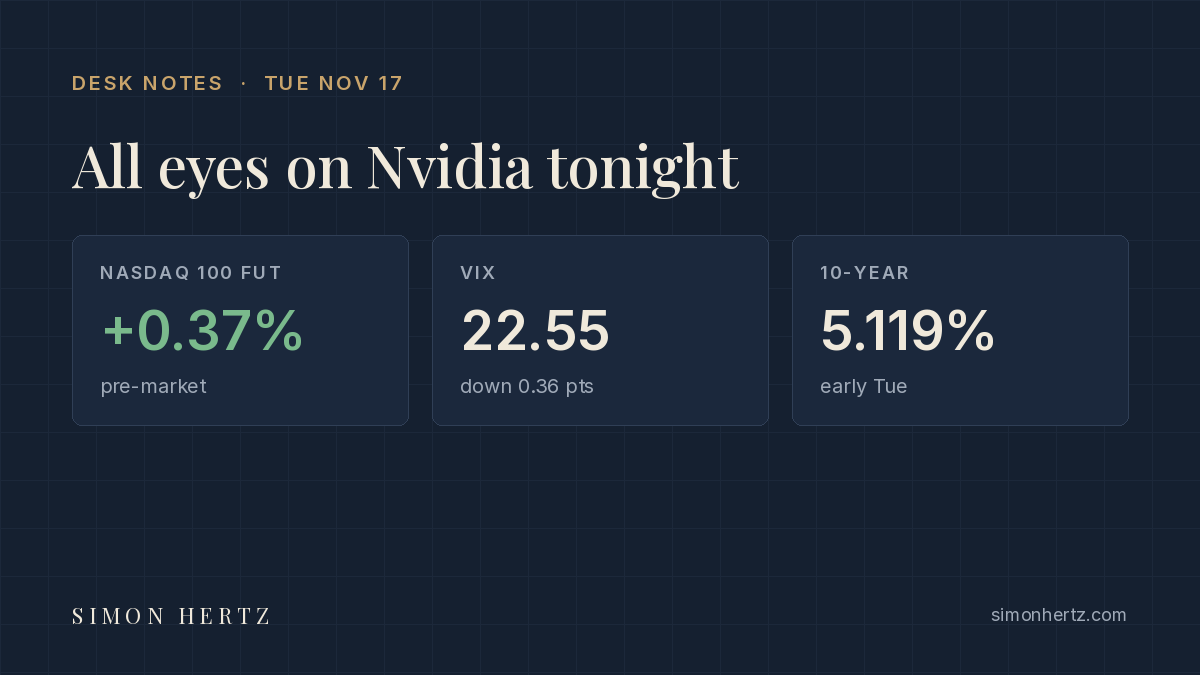
Tuesday, November 17, 2026: futures are split after Monday’s tech rout, and the whole day leans toward one report after the bell. At 7:07 a.m. ET, Nasdaq 100 futures were at 27,385.25, up 101 points or 0.37%; S&P 500 futures were at 7,441.00, up 2 points or 0.03%; and Dow futures were at 51,434, down 236 or 0.46% (CNBC). October retail sales come out at 8:30 a.m., four Fed officials speak during the day, and Nvidia reports after the close. Monday saw the Nasdaq fall 2.49% and the S&P 500 1.92% (Trading Economics). Last session in detail: Closing Notes for Monday.
Before the bell
- Futures. The CNBC readings above are measured against the prior settle. Yahoo Finance showed Nasdaq 100 futures at 27,389.25, up 0.38%, at 7:08 a.m. ET. Tech is trying to steady while the Dow lags, the reverse of the pattern at the start of the week.
- Nvidia. Shares were at $157.60 in early trading at 7:18 a.m. ET, up $1.46 or 0.94% from Monday’s close of $156.14, which followed a 4.12% drop (CNBC). The company reports after the market close today (CNBC). The stock has been hit by the leadership turmoil that followed its CEO’s departure, and Monday’s selling spread to other chip names such as Micron and AMD (Trading Economics).
- Retail earnings. Home Depot reported earnings per share of $3.86, above expectations (Trading Economics); its shares were at $341.25 at 7:17 a.m. ET, down $6.26 or 1.80% from Monday’s close (CNBC). Walt Disney reported $1.77 a share, below expectations (Trading Economics); its stock was little changed at $118.60 at 7:18 a.m. ET (CNBC).
- AI listing. Investors are also watching Anthropic’s market debut this week for a read on demand for AI stocks (Trading Economics).
- VIX. 22.55, down 0.36 point, at 7:17 a.m. ET (CNBC); Yahoo Finance showed 22.52.
- Yields. At 7:18 a.m. ET the 10-year Treasury yielded 5.119%, down 0.002 point; the 2-year 4.815%, down 0.012; and the 30-year 5.468%, unchanged (CNBC).
- Oil. WTI crude for December was $86.28 a barrel, up $0.56 or 0.65%, at 7:08 a.m. ET (CNBC).
On today’s calendar
- 7:30 a.m. ET: St. Louis Fed President Musalem speaks (Trading Economics).
- 8:15 a.m. ET: ADP weekly employment change; the prior reading was 19,750 (Trading Economics).
- 8:30 a.m. ET: October retail sales. Consensus 0.2% after 0.8%; excluding autos, 0.4% after 0.9%; the control group, 0.4% after 0.1%. October import prices (consensus 0.7% after 1.1%) and export prices (consensus 0.3% after 2.2%) come out at the same time, along with the NY Fed services index, last at -20.7 (Trading Economics).
- 9:15 a.m. ET: October industrial production, consensus 0.1% after 0.7%; capacity utilization, consensus 76.8% after 76.9% (Trading Economics).
- 9:20 a.m. ET: Fed Governor Waller speaks; 9:30 a.m.: Cleveland Fed President Hammack (Trading Economics).
- 10:00 a.m. ET: NAHB housing market index, consensus 29 after 29; September business inventories (Trading Economics).
- 2:25 p.m. ET: New York Fed President Williams speaks (Trading Economics).
- After the close: Nvidia’s quarterly report (CNBC).
Later this week: housing starts, a 20-year bond auction at 1:00 p.m. and the FOMC minutes at 2:00 p.m. ET on Wednesday; jobless claims and the Philadelphia Fed index on Thursday; the final University of Michigan sentiment reading on Friday (Trading Economics).
What it means for options traders
What a 22.55 VIX prices. Dividing by 16 gives about 1.41% a day, or roughly 105 points on S&P 500 futures at this morning’s level. It is a rule of thumb, not a forecast. The VIX eased a little overnight, but it is still well above where it began the week, so protection remains expensive going into the report.
Two events, two clocks. Retail sales hit at 8:30 a.m., an hour before the cash open, so most of that reaction shows up in futures and in the opening print. Nvidia lands after 4:00 p.m., so today’s same-day index options expire before it. That split matters: a position that expires at today’s close carries the data and the Fed speakers but not the earnings; anything expiring Wednesday or later carries the report too, and is priced that way.
The event kink in the term structure. Nvidia options expiring this week hold the earnings premium; after the number, much of that implied volatility usually drains out quickly, whatever the direction. That is the setting where structures like butterflies and calendars get discussed: a butterfly centered near the current price is a bet that the move comes in smaller than priced, while a calendar sells the inflated front expiration against a later one. Both have defined risk, and both can lose if the move is larger than the market expected. Because Nvidia is so heavily weighted, the same logic reaches the Nasdaq 100 and, to a lesser extent, the S&P 500.
Rates in the background. With the 10-year near 5.12% and the FOMC minutes and a 20-year auction due Wednesday, yields can still pull equity volatility around mid-week, separate from earnings.
0DTE conditions today. Tuesday expirations carry the retail sales reaction at the open, Waller and Hammack early in the session and Williams in the afternoon, then expire just before the biggest earnings report of the week. A defined-risk structure such as a vertical spread or an iron condor fixes the worst case before entry. Size from that worst case, not from the premium collected.
Desk rule for today: know which side of 4:00 p.m. your expiration sits on.
Sources
- CNBC quotes: S&P 500 futures, Nasdaq 100 futures, Dow futures, NVIDIA (NVDA), Home Depot (HD), Walt Disney (DIS), VIX, 2-year, 10-year and 30-year Treasury yields, WTI crude.
- Yahoo Finance: Nasdaq 100 futures, VIX.
- Trading Economics: US economic calendar; US stock market; Home Depot EPS; Walt Disney EPS.
Related reading
- Trading Butterflies by Simon Hertz, available on Amazon.
- Trading Calendars by Simon Hertz, available on Amazon.
- Trading 0DTE Spreads by Simon Hertz, available on Amazon.
- All titles: Simon Hertz author page on Amazon.
This post is for education only. It is not investment advice or a recommendation to buy or sell any security or option. Options involve risk and are not suitable for all investors. Figures are from the sources listed and may be revised; check primary sources before relying on any number.