Nasdaq Futures Slide 1.9% as Chip Selloff Spreads; Waller and Michigan Sentiment Ahead: Desk Notes for Friday
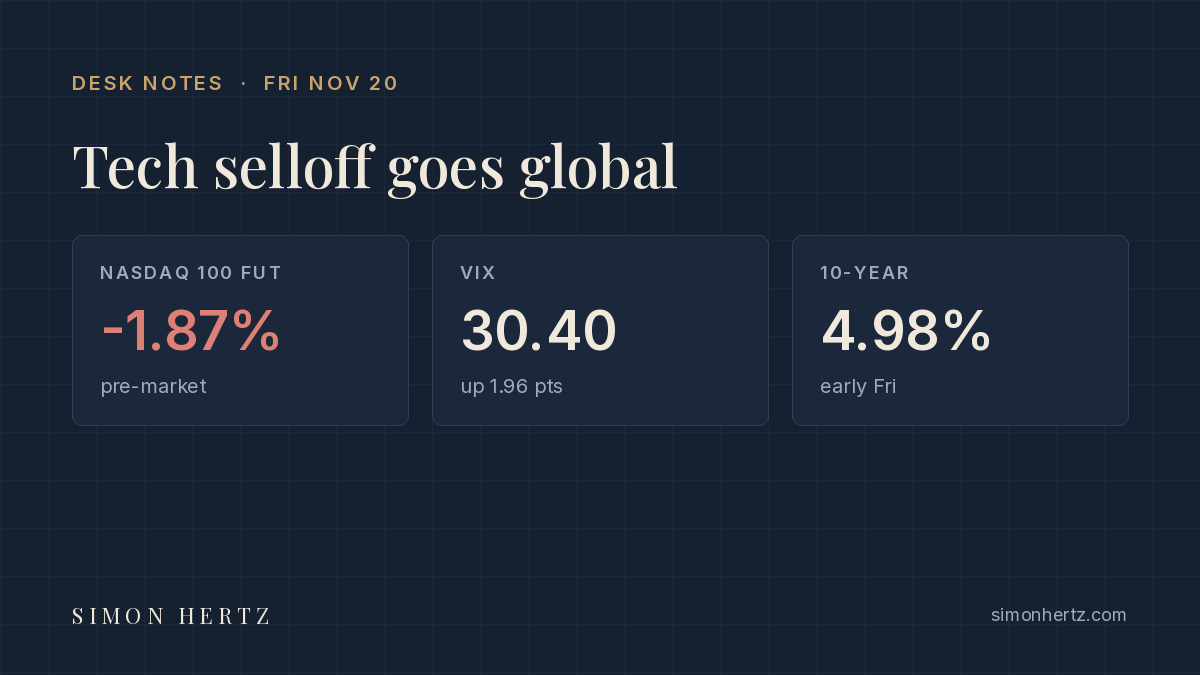
Friday, November 20, 2026: futures are lower again this morning, and technology is leading the way down. At 7:08 a.m. ET, Nasdaq 100 futures were at 26,103, down 497.25 points or 1.87%; at 7:07 a.m., S&P 500 futures were at 7,135.50, down 61.75 or 0.86%, and Dow futures were at 49,094, down 86 or 0.17% (CNBC). The selling picked up overnight in Asia and spread to Europe, and Anthropic was indicated lower before the open after its debut. The U.S. day turns on two Fed governors, Christopher Waller before the open and Lisa Cook at midday, with final University of Michigan sentiment in between. Thursday ended with the Dow down 1,101.11 points and all three major averages off more than 2%. Last session in detail: Closing Notes.
Before the bell
- Futures. The CNBC readings above are measured against the prior settle. The order of the losses, Nasdaq first, S&P 500 next and the Dow last, is the mirror image of Thursday morning’s tech-led rally.
- Big Tech and chips. Early this morning Nvidia was down 1.9% before the open, at its lowest level in more than a year, with Broadcom down 3%, AMD 4.95% and Micron 3.8%. Alphabet, Meta, Microsoft, Amazon and Tesla were also lower, while Apple was up 0.5%. Anthropic was indicated about 6% lower at 4:25 a.m. ET (CNBC). Late Thursday, California’s attorney general sent Nvidia an investigative subpoena over whether its advanced chips reached China (CNBC).
- Overnight. Japan’s Nikkei 225 fell 5.06% and South Korea’s Kospi 5.21%; SoftBank Group closed down 14.48%, its worst day since August 2024, and Taiwan’s Taiex is heading for its steepest weekly drop since 1997. In Europe, the Stoxx 600 opened down 0.83%, with the region’s tech stocks down 2.7% and chip names ASML and ASM International among the hardest hit (CNBC).
- VIX. 30.40, up 1.96 points or 6.89%, at 7:18 a.m. ET (CNBC).
- Yields. Treasuries are rallying as money looks for safety. At 7:18 a.m. ET the 10-year yielded 4.98%, down 0.072 point, and the 2-year 4.704%, down 0.075 (CNBC). Earlier in the morning CNBC put the 30-year about 4 basis points lower at 5.361%.
- Oil and gold. WTI crude was $82.84 a barrel, down $0.37 or 0.44%, at 7:07 a.m. ET (CNBC). Spot gold fell 2.81% to $3,520.05 an ounce overnight, a low of more than a year, citing Reuters (CNBC).
On today’s calendar
- 8:25 a.m. ET: Fed Governor Christopher Waller speaks (Trading Economics; CNBC).
- 10:00 a.m. ET: University of Michigan consumer sentiment, final November reading, with its one-year and five-year inflation expectations (Trading Economics).
- 12:15 p.m. ET: Fed Governor Lisa Cook speaks (Trading Economics).
- 1:00 p.m. ET: Baker Hughes rig count (Trading Economics).
- Monday: flash S&P Global PMIs for November at 9:45 a.m. and a 2-year note auction at 1:00 p.m. open next week, which is shortened by Thanksgiving; PCE inflation, the second estimate of third-quarter GDP and durable goods all come Wednesday (Trading Economics).
What it means for options traders
What a 30.40 VIX prices. Dividing by 16 gives about 1.9% a day, or roughly 136 points on S&P 500 futures at this morning’s level. It is a rule of thumb, not a forecast. Thursday showed how fast that range can be used: the market went from a gap up to a 2% loss in one session. With the VIX above 30, option premiums are rich on both sides, and that changes how verticals behave.
Verticals when volatility is high. High implied volatility raises the price of both legs of a vertical, so the spread’s cost or credit moves less than either option on its own. That is one reason defined-risk spreads hold up better than single options when vol is elevated: the short leg offsets part of the vol premium paid on the long leg. Wider strikes give more room but put more capital at risk; the maximum loss is still known before entry.
Skew and the tech-heavy indexes. The Nasdaq 100 is falling more than twice as fast as the S&P 500 before the open. In a selloff like this, out-of-the-money puts usually gain implied volatility faster than calls, so put spreads cost more and call spreads less than the distance between strikes alone would suggest. Comparing skew in Nasdaq 100 and S&P 500 options is a quick read on where the stress sits.
Rates in the other direction. Yields are falling with stocks this morning, which is the safe-haven pattern, not the inflation scare of the past few weeks. Waller speaks before the open, so his remarks can reset rate expectations and equity vol before today’s options start trading; Cook’s remarks come in the middle of the session.
0DTE conditions and the weekend. Friday’s expirations carry Waller at the open, Michigan sentiment at 10:00 and Cook at midday. Anything that happens over the weekend reaches only next week’s options, and with Thanksgiving ahead, next week has fewer trading days and a heavy Wednesday. On a morning with the VIX above 30, size from the defined maximum loss, not from the size of the premium.
Desk rule for today: when vol is high, let the spread carry the risk, not the position size.
Sources
- CNBC quotes: S&P 500 futures, Nasdaq 100 futures, Dow futures, VIX, 2-year and 10-year Treasury yields, WTI crude.
- CNBC: Stock market today: live updates.
- Trading Economics: US economic calendar.
Related reading
- Trading Verticals by Simon Hertz, available on Amazon.
- Trading 0DTE Spreads by Simon Hertz, available on Amazon.
- Trading Calendars by Simon Hertz, available on Amazon.
- All titles: Simon Hertz author page on Amazon.
This post is for education only. It is not investment advice or a recommendation to buy or sell any security or option. Options involve risk and are not suitable for all investors. Figures are from the sources listed and may be revised; check primary sources before relying on any number.